
What makes a good deal?
Clear savings, vegan eligibility, and helpful details for strong Vegan Deals submissions.
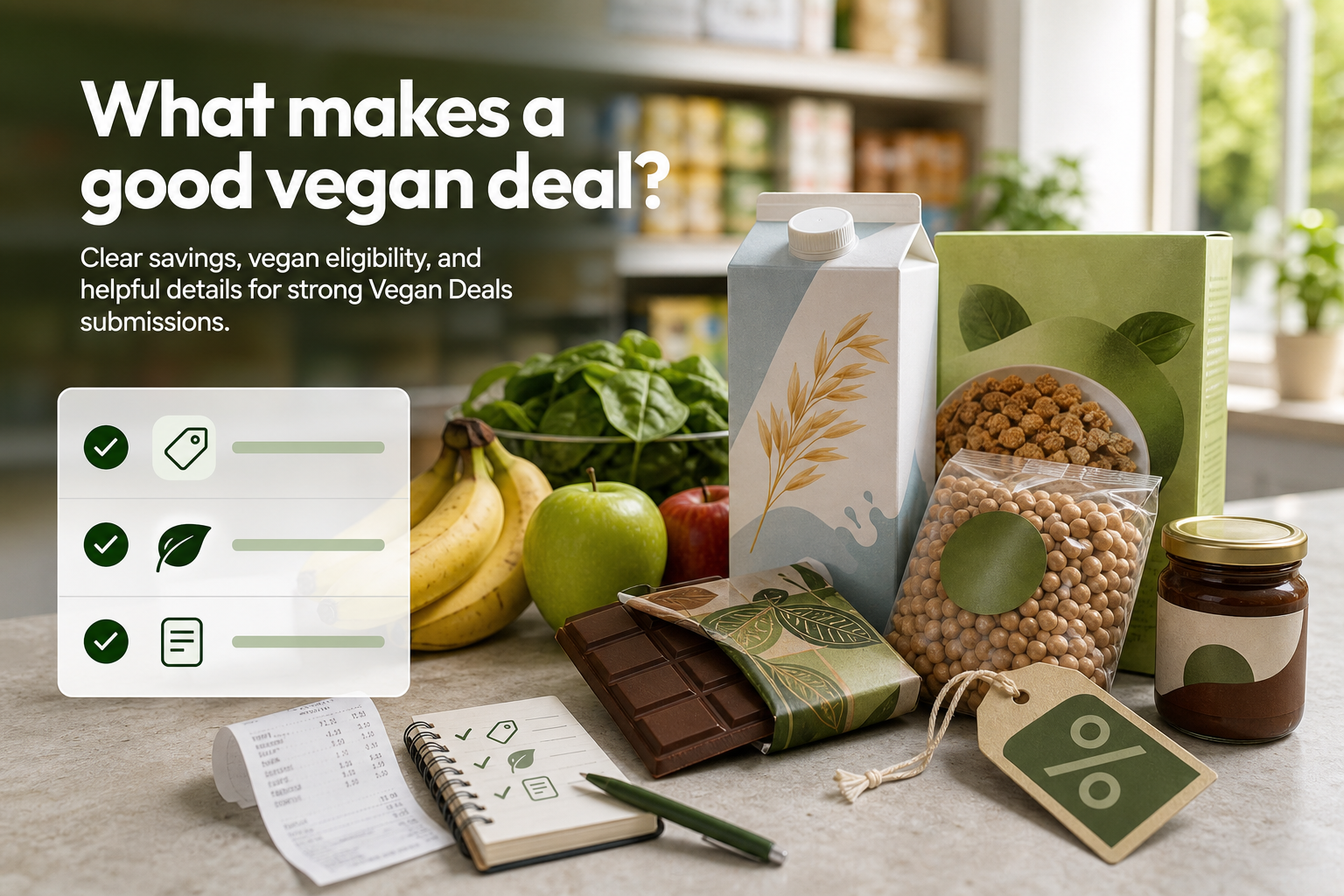
A good deal is simple: a real saving, clear details, and enough information that someone else can buy it without guessing. That is exactly what our deal guidelines ask for.
Show the saving
Include the usual or RRP price and the discounted price — or a working discount code with any catches.
Make it usable
Add a working product URL, clear title, and useful tags. Mention loyalty prices, cashback, student discounts, or free shipping if they stack.
Say why it is worth it
One or two honest sentences beat hype. Size, pack count, and expiry help everyone.
Not every discount is worth your friends' time. A deal that shows "50% off" but hides a £30 minimum spend, applies only to non-vegan variants, or uses an expired code isn't really a deal at all. It's noise. On Vegan Deals, the goal is the opposite: a community where every shared offer is actually usable, genuinely saves money, and is relevant to the people reading the feed.
This guide gives you a practical checklist for spotting (and posting) shareable deals. Whether you're browsing for yourself or submitting something new to the community, run through these three pillars first.
Quick contrast:
- Good deal: "Oatly Barista 6 x 1L, now £7.50, was £10.50 (29% off) @ Ocado. Free delivery. No code needed. In stock now."
- Not-good deal: "Up to 50% off plant-based drinks at various stores" (no retailer, no product, no expiry, no link)
Pillar 1: trust first, the non-negotiables
Research published in a NIH/PMC source-credibility overview confirms that credibility breaks down into perceived expertise, competence, and reliability. For deals, that means every submission needs to pass a basic honesty test before it earns a share.
Ask yourself:
- Is the retailer clearly named with a working, direct link to the product or offer page?
- Is the exact product specified (brand, size, flavour, SKU where possible)?
- Is there a confirmed expiry date, or at minimum a "last checked" timestamp?
- Does the "was" price reflect what the retailer actually charged recently? The ASA's guidance on promotional savings claims (published May 2026) says a savings claim is only valid if the product was genuinely sold at the higher reference price. "Was £20, now £10" needs to be real, not an inflated anchor.
- Are minimum spend thresholds, new-customer-only restrictions, and product exclusions clearly stated?
A deal with vague terms or a made-up RRP actively harms the community. If you can't verify the reference price, don't present the saving as a percentage.
On Vegan Deals, the deal guidelines set out exactly what a well-structured submission looks like, worth a read before you post.
Pillar 2: real value, is the saving genuinely worth it?
A ScienceDirect meta-analysis on digital purchasing found that trust and perceived risk are among the strongest predictors of online purchase decisions. Unclear savings increase perceived risk, which means fewer people act on the deal.
Do the maths properly:
- State the discounted price, the previous price, and the percentage saved in plain figures.
- Factor in delivery. A £3 saving disappears if delivery adds £3.99. Always note whether delivery is free, or flag the qualifying spend for free shipping.
- Watch out for subscription traps. "Subscribe & Save" prices look great, but they're conditional, say so.
- "Up to X%" wording is only helpful if you explain what most people actually qualify for. If the headline says "up to 40% off" but the majority of products are 10% off, flag that.
- Consider whether the saving is useful at that product size or format. A 5 kg bulk bag of protein powder at 20% off isn't a deal for someone in a studio flat with no storage.
A Springer Nature study on consumer perceptions of price discounts found that how a discount is framed shapes whether shoppers believe it's genuine. Showing the maths clearly builds that belief.
Pillar 3: vegan product suitability, not just discounted, but right
This is where Vegan Deals differs from general deal aggregators. A product being on sale doesn't make it worth sharing here. It also needs to be verifiably vegan-friendly.
Before sharing, check:
- Does the product carry a recognised vegan certification (Vegan Society, V-Label), or does the ingredient list confirm no animal-derived ingredients?
- Is there a cross-contamination risk that the community needs to know about? Mention it if so, don't leave shoppers to find out themselves.
- Is the format practical? A chocolate bar deal is different from a powder supplement deal. Size, shelf life, and use-case all affect whether the saving is genuinely useful.
- Avoid sharing deals on products that have a track record of complaints or returns. A discount on something that doesn't taste right, or that's repeatedly reported as mislabelled, is not worth amplifying.
For anything with ambiguous labelling, some alcohols, certain E-numbers, shared-factory products, a short note in your deal description keeps the community informed rather than surprised. Browse the alcohol deals section for examples: not all drinks are as vegan as they appear, and the best submissions say so upfront.
How to spot a voucher code deal that's actually usable
Voucher codes have specific failure modes that product discounts don't. Before sharing a vegan discount code in the UK, check every one of these:
- Minimum spend: does the code require a £25, £40, or £50 basket? If so, say it.
- Exclusions: codes often exclude sale items, specific brands, or new arrivals. Check the terms page, not just the homepage banner.
- Stacking rules: can this code be combined with a student discount, cashback via Quidco or TopCashback, or a loyalty scheme offer? If it can (or can't), that's useful information. The deal guidelines on Vegan Deals explicitly encourage noting cashback opportunities and student discount combinations.
- New vs existing customers: many codes only work on a first order. A deal labelled as open to all when it's actually new-customer-only wastes everyone's time.
- Test the code before you post it. Copy-paste it into a browser, add a qualifying item, and confirm it applies at checkout. Expired codes cause frustration, a GOV.UK consumer behaviour review from April 2017 identified easy-to-use interfaces and secure, reliable processes as core to positive online purchasing experiences. Broken codes are the opposite of that.
If a code fails at checkout despite apparently valid terms, it's worth leaving a comment on the deal rather than deleting it. Others may be able to confirm whether it's a browser issue, a region restriction, or a genuine expiry.
The community test: is it worth an upvote?
UGC (user-generated content) is considered inherently more trustworthy than editorial content because it comes from real shoppers with no commercial motive, according to Nosto's 2022 research on UGC in marketing. That's exactly why community votes on Vegan Deals matter, but they should reward the right things.
Before upvoting or sharing, ask:
- Does the deal description answer the obvious questions: delivery, expiry, eligibility, vegan suitability?
- Could someone redeem this in under 30 seconds after clicking the link?
- Is the description specific, or is it vague enough to mislead?
Vote for reliability and usefulness, not just the biggest percentage number. A verified 15% off a product you can actually buy today is worth more to the community than a flashy "up to 60% off" with hidden conditions.
Leave helpful comments too: "worked for me this morning", "code expired as of yesterday", "only applies to the 1kg bag, not the 500g", these small additions make the whole community sharper. Check the community guidelines for the full code of conduct.
Copy-and-post template for a deal worth sharing
Use this structure for every submission to the Vegan Deals platform:
Title: [Brand + Product + Size] – [Price] (was [RRP], [%] off) @ [Retailer]

What you get: [1–2 sentences on the product and why it's useful]

Vegan note: [Certified vegan / ingredient-confirmed / check allergen label for X]

Price: Now £X | Was £X | Saving: £X (X% off)

Delivery: [Free / £X / free over £X spend]

Code (if applicable): [CODE] — min. spend £X, excludes [Y], new customers only / all customers

Expiry / eligibility: [Date or "no end date stated, last checked DD/MM/YYYY"]

How to redeem: ["Add to basket, enter code at checkout in the promo box"]

Link: [Direct URL to product or offer page]
Shareable summary formula: "Save £X on [vegan product] by [entering code / clicking link] before [expiry or 'while stocks last']."
Common mistakes to avoid
- Using an inflated or fabricated "was" price to make the saving look bigger than it is
- Forgetting to mention minimum spend or new-customer-only restrictions
- Vague expiry like "limited time" without a date or last-checked note
- Not confirming vegan suitability, especially for cosmetics, supplements, and alcohol
- Sharing a code you haven't personally tested in the current session
Browse the latest deals on the platform to see well-structured submissions in practice, they make the difference between a listing that gets 30 upvotes and one that gets ignored.
Frequently asked questions
Can I share deals with "up to" wording? Yes, but be specific about what the majority of eligible items are discounted by. "Up to 40% off, most items 15–20% off" is honest. "Up to 40% off" with no further detail is misleading.
What if the code fails at checkout? Check the terms for minimum spend, exclusions, and customer eligibility first. If it still fails, leave a comment on the deal so others know. Don't silently delete, that removes useful information.
Does delivery cost count towards the real saving? Absolutely. If the product is £2 cheaper but delivery adds £3.99 with no free-delivery threshold you qualify for, the deal costs more, not less. Always include delivery in your net saving calculation.
How do I confirm vegan suitability quickly? Look for the Vegan Society or V-Label logo first. If absent, scan the ingredient list for obvious animal derivatives (milk, honey, beeswax, carmine, gelatine, lanolin). For drinks and cosmetics, check the brand's FAQ page or contact them directly, it takes two minutes and protects the community. Supplements deals in particular often need this extra check, as capsule shells are not always plant-based.
What about stackable discounts? If a student discount, cashback platform, or loyalty scheme can be stacked with the deal, mention it. It turns a good deal into a great one. If stacking is explicitly excluded by the terms, say that too.
Run every deal you share through this checklist before you post it. If it passes all three pillars, trust, real value, and vegan suitability, it's worth the community's time. If it doesn't, either fill in the gaps or hold off until you can.
Ready to contribute? Read the full deal guidelines and submit your next find to the Vegan Deals community. And if a deal you've shared stops working, report it, that's just as valuable as finding it in the first place.
Related posts
How to submit a deal on Vegan Deals
Simple 1-2-3 guide to sharing a vegan bargain with the UK community.
·6 min read
What is vegan-deals.co.uk?
A UK community bringing vegan deals together like HotUKDeals but vegan-only.
·4 min read
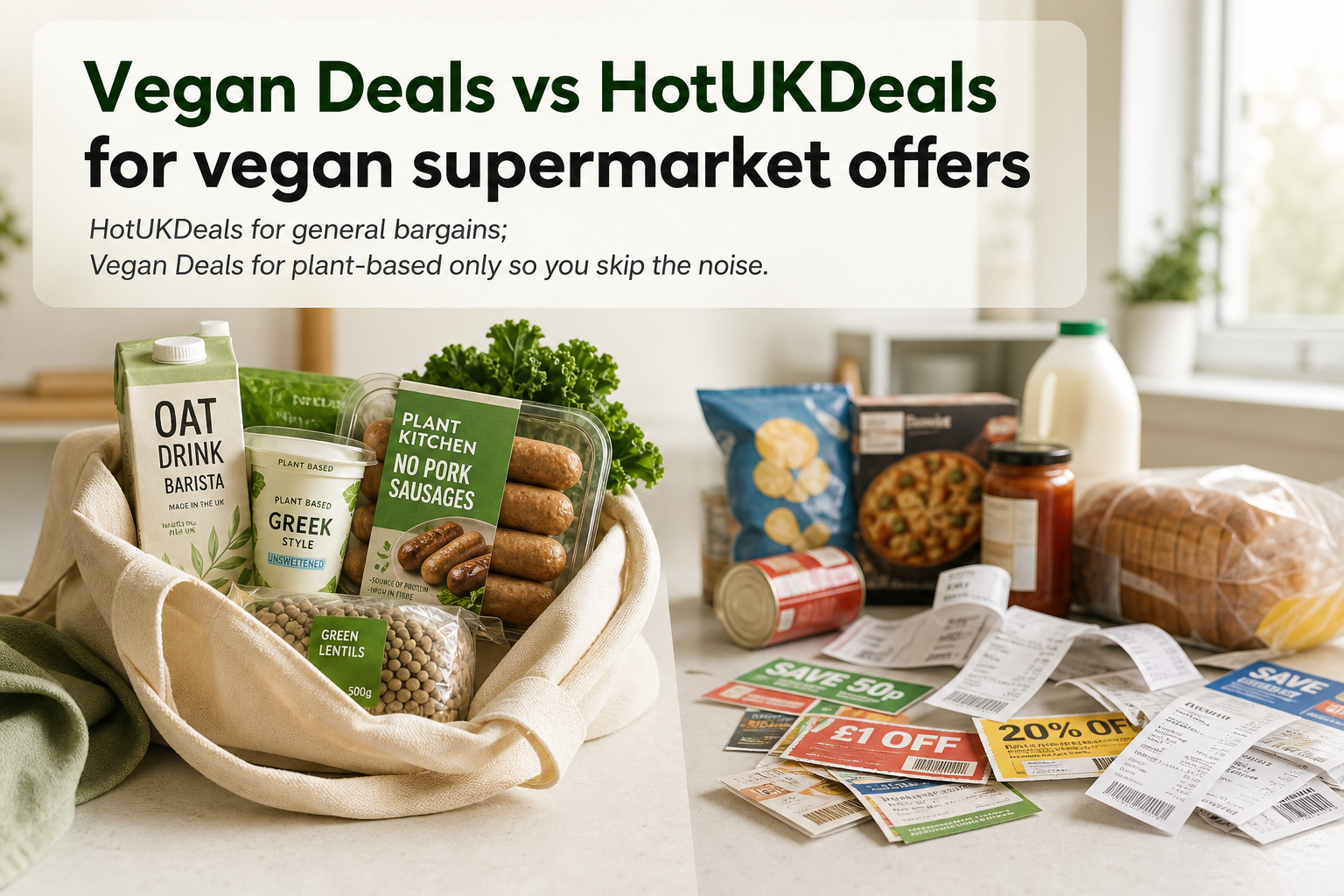
Vegan Deals vs HotUKDeals for supermarket offers
HotUKDeals for general bargains; Vegan Deals for plant-based only so you skip the noise.
·6 min read